
 By Jenna Collyer
Profit and loss (or ‘P&L’) is a term that’s used all the time by business leaders. But for a lot of people working in an agency, it’s just another dry accounting statement they can leave for the financial bods. And yes, it is an important part of your annual accounts. But it goes way beyond compliance with a yearly statement. In fact, a profit and loss report is crucial to monitoring and forecasting the financial health of a business, fundamental to stability and success.
For team members, this translates into job security, salary increases, bonuses and a steady, stable stream of work.
Here, we’ll explore just what profit and loss actually means, why everyone needs to know about it and the wider implications for an agency.
What exactly is profit and loss and why is it so important?
According to Investopedia the definition of profit and loss is ‘a financial statement that outlines a company’s revenue, costs and expenses over a specified period of time’.
Although you formally only need this financial statement once a year, most agencies run a monthly P&L report as well as a 12-month rolling report, to monitor and track profits. Some have forecasted P&L targets, so this allows them to compare actual vs forecast to see if they’re on track for the year.
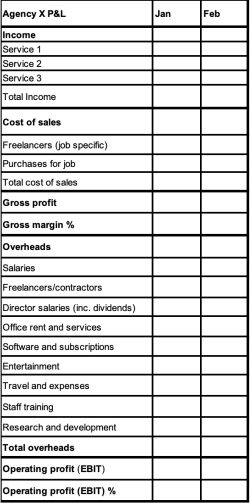
In simple terms, the statement is a spreadsheet showing:
Total income minus cost of sales (= gross profit) minus operating expenses (= operating profit)
Income and costs can be split out into categories or pots (aka ‘nominal codes’) to make it easier to analyse them and compare different periods.
For example:
Income (aka sales, turnover or amount invoiced)
This can be split by service, client, existing vs new business etc. However, we wouldn’t recommend you to split it out into departmental revenue, as this can open a whole other can of worms. If you’re using the revenue management function on Synergist, the revenue and costs will go into the P&L calculation when they are incurred.
Cost of sales
Here, you can include any specific job costs or expenses, such as media buys, printing, job-specific freelancers or extra materials for a photoshoot.
Operating expenses (aka overheads)
These are the costs of running the agency that are incurred regardless of what work is coming in, so can’t be traced to a particular job. Think things like salaries, freelancers/contractors, office costs, marketing, software subscriptions, insurance and training. These can also be split these into fixed and variable costs. As the name suggests, fixed costs don’t change while variable costs can.
Here’s an example of what the spreadsheet might look like:
The power of EBIT
Operating profit is also known as EBIT (Earnings Before Interest and Taxes). This is a good indicator of how much profit the agency will keep in that period, before corporate tax deductions, and removes the factors that business owners have discretion over, such as debt financing, capital structure and methods of depreciation.
To get the profit margin as a percentage, divide EBIT by sales revenue. This can then be used to evaluate and benchmark an agency’s operating performance against previous operating margins (or to those of other agencies). Agency leaders: go for it and be ambitious – set your agency a target of 20% EBIT.
Each month, your agency’s finance team (or person) can pull together the month-end P&L to show what income, gross and net profit has been made that month. But if jobs billed or costs allocated are not uploaded correctly within the month, the P&L figure won’t be right. For example, if you forget to bill a client for £50k in January but your sales costs have come in, January will show as a negative profit.
This might not seem too important, as the money will come in eventually, but it will impact your agency’s cashflow. Salaries and overheads still need to be paid. Even with money in the bank to cover them, negative profits essentially mean a loss and that’s not a good figure for the books, especially if you’re looking to sell the agency at some point. So when finance asks for everything to be billed and for costs to be in by the end of the month – that’s why!
A misconception about earnings is that directors take home the profits – but they should be taking a salary. Operating profit is money left once all business costs are covered.
Sometimes this is kept as ‘retained profit’ to cover salaries in the event of a slow month (in fact, it’s a good idea to keep at least six months’ worth of overheads in a separate buffer account). And this profit can be used to invest in growing the agency – such as increasing marketing spend, hiring more staff, purchasing new equipment, supporting training and rewarding the team with bonuses. Plus it’s great for the extra stuff, the things that make agencies what they are – like away days and team get togethers.
In a nutshell, profit and loss is for everyone, not just for finance. Yes it’s important for the figures. But equally, it’s about building success, boosting reputation and confidence, sustaining jobs and keeping the cashflow healthy. It’s in everyone’s interests to understand and to contribute… by logging timesheets, hours, expenses and costs accurately and regularly.